

Most folks probably won’t care about my summer research project. But I’m kind of proud of it.
Some elements I’ve learned about my true self is I love to learn about new things, l can get lost for hours delving into research on a topic, and I adore synthesizing that research into “so what”. I was fortunate that I was able to utilize all those skills in my career! Finding outlets for them now in retirement is a bit more challenging. If you have followed my blog for a while, you have caught a few of those research “rabbit holes” from learning about Enneagrams to Chakras to women’s archetypes to the history of mankind. This summer it was about plants.
You may ask, why plants? With last year’s multiple salt water storm surges and more expected this year, I wanted to understand what plants were salt tolerant in our Zone. I also was intrigued with possibly becoming a Master Gardener, to further my gardening hobby. It was amazing how much I could find on-line as far as learning about plants!
I lost track of how many Master Gardener seminars I listened to, but it was more than 10! I did multiple seminars on plant identification (learning about plant biology) and Florida-Friendly landscape design, and individual ones on invasive plants, palms, and weeds. I know I studied in depth over 100 “potentially salt tolerant plants” plus the 150 plants that I have on my own property. I say “potentially” as I found them on various lists but needed to confirm both if they were really salt tolerant and were ok for my Zone. I found great information of sites like Florida Native Plants Society (link here) and the Florida Extension Programs (link here).
Here are some of my ahas:
- I am in Zone 10a. When I moved to Florida 3 years ago, it was Zone 9b. Yes, that makes a difference for plant survival! And just because the Big Box stores sell a plant locally does not mean it will survive in our Zone.
- Plants installed within about one-eighth of a mile of saltwater should be at least somewhat salt tolerant as salt is in the air and dirt (or sand as our dirt is mostly sand!). Of course, some of my plants are less than two feet from salt water.
- Storm surge tolerant is different than salt water tolerant. Storm surge tolerant means the plant can withstand saltwater inundation as in storm surge. Salt water tolerant alone refers to tolerance to salt spray or salt in the air, that one-eighth of a mile thing. And a plant can be one or the other, or both, or neither.
- Plant survival is all about putting the right plant in the right place. Sun/shade, alkaline or acidic soil, wet/dry. And a weed is just a flower/plant somewhere you don’t want it.
- Florida native plants are more likely to survive and thrive as they are durable, low-maintenance, usually drought and heat tolerant, and support the eco-system. Going native does not have to mean going wild; many native plants can be maintained as hedges or in planting beds.
- Plants include palm trees, grasses, ferns, flowering plants, foliage hedge plants, succulents, vines, wildflowers, and more. A cactus is a succulent; but not all succulents are cacti.
- Green is a color. Since most native plants have smaller flowers, it’s important to think about mixing different shades of green, as well as different shapes, sizes, and textures to create an interesting landscape design.
- There is no such thing as a NO maintenance yard in Florida.
What else did I discover? Of my current 150 unique species of plant, only 35 are salt water tolerant, and only 3 are storm surge tolerant.(Ouch) However, I identified 38 plants that are both salt spray tolerant and storm surge tolerant, 32 that are salt spray only tolerant, and another 8 that are storm surge only tolerant. My next few trips to the local garden stores will be much different, including what I’m putting into our new planting beds. I have a list of plants to find as I expect this year’s storm surges will take out more of my plants. Unfortunately, meteorologists have predicted a “bad year” for September and October hurricanes/storms.
I have also created a handout of both salt-spray tolerant and storm-surge tolerant plants to share at my garden club events this fall. I am not the only one dealing with increases in storm surges. For perspective, our area until 2 years ago had not had a bad storm surge in 25 years, so this knowledge is not that common!
So that’s my summer research summary. I also did conclude I do not want to work towards Master Gardener credentialing. I have limited desire to learn about vegetable gardening, plant diseases, and insects, all critical aspects of the Master Gardener program. I enjoyed learning about plant identification and finding the resources to explore any new plant that might come my way at the garden club. I’ll remain a gardener hobbyist!
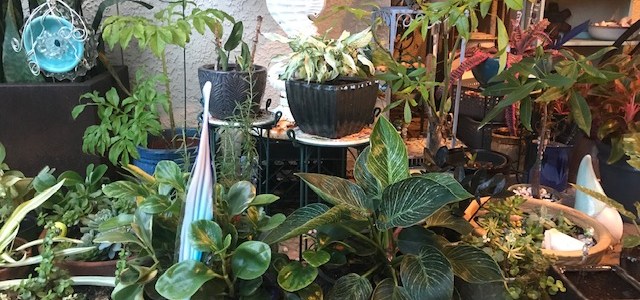
Picture: A few of my 150 plants.
Copyright © 2024 retirementtransition.blog – All rights reserved.

 retirementtransition
I admire you to taking the time to really learn what you wanted to know about plants. I’m not much of a gardener, although I do grow indoor cannabis. I don’t pay enough attention to the details and know I need to read more, but for some reason, I can’t get into it.
LikeLiked by 1 person
We all find the things that interest us. I was surprised how much I enjoyed exploring salt tolerant plants and the ones I have in my yard. But I started to just explore by plant family (there are 150 plant families in Florida I think), and just couldn’t go there. Maybe next summer I might explore weeds versus native wildflowers in more depth as that is still an interest for me. Or maybe by then I’ll have something else I’m intrigued with, not plants! I am a researcher, and love this kind of learning.
LikeLike
The term “good enough” comes to mind. There are some things that need not be mastered yet a good working knowledge is beneficial. My mom often said – a weed is just a perennial gone amok. And gardening is an exercise in hope some days in spite of our expertise; there are so many subtle variables. Enjoy!
LikeLiked by 1 person
“Perennial gone amok” is a phrase I have note heard! Folks here also talk about “volunteers” in the garden. Plants that come up without you planting them. I’m still trying to determine which “volunteers” in my yard are invasive non-native weeds, which are native wildflowers, and which are simply random volunteers!
LikeLike
Hi Pat, I think it is great that you allowed yourself to learn and explore to the extent needed for your situation. I’m sure your garden club will appreciate the flyer and benefit from your work.
I know what you mean about not wanting to pursue mastery. There was a time when I thought I wanted to become a professional photographer. I realized that what I really wanted was to produce better quality and more artistic photographs that please me. ‘Hobbyist’ works for me too.
P.S. we are in Zone 10a also, as we are directly across the state. But, our conditions are a little different. We are twenty minutes from the ocean, but the river that spills into the preserve behind our house is brackish. Sitting on top of a limestone shelf makes growing anything a challenge. Thank goodness for palm trees!
LikeLiked by 1 person
Suzanne, When I was exploring plants, I did come across ones that did okay with brackish water! I didn’t keep those in my list because I was salt focused.
Then last weekend I went to a talk on “balcony gardens” – not that I have a condo balcony, but it was a good chat on creating a “garden look” with containers. I found it inspiring, and yes, it made me want to buy more plants! Containers can be moved out of salt flooding areas.
And yes, palms. We have over 60 on our property, mostly Areca’s and Washintonians, but a number of others as well… 9 varieties in total. So Florida!
LikeLike
Sounds like a great hobby.
LikeLiked by 1 person
I’m surprised how much I’m enjoying it. I’m not quite to the every day in the garden that a few other gardening folks I know are. Luckily hubby helps with the palm tree fronds, and I have a lawn guy who does the grass. So I can focus on puttering with plants (and weeds!).
LikeLiked by 1 person
Hi Pat – I think you’ve gotten your learning balance spot on. You mined for all the knowledge that’s applicable without going down the rabbit hole of knowledge for knowledge’s sake. Having a garden that you love and that survives any of nature’s curveballs is a wonderful achievement – knowing that what you’re creating is going to last the distance must be very rewarding.
LikeLiked by 1 person
Leanne, It felt a bit rabbit hole a number of times though! But I’m much more confident in what to replace things with if we again get salt water surge that kills off more plants. I do enjoy learning, and summer here is a great time for it as it’s so hot during the day.
I’m excited that one of my Garden Clubs is coming to see my gardens in November (unless I flood again). They started a member-garden tour program this year and asked me to participate. Yes, I’m watching the news channels regularly for hurricane information.
LikeLike